BLACKSTONE & MONTGOMERY
Blackstone Apartments and Montgomery residence halls
Portland State University
Updated April 21, 2026
Description and cultural significance:
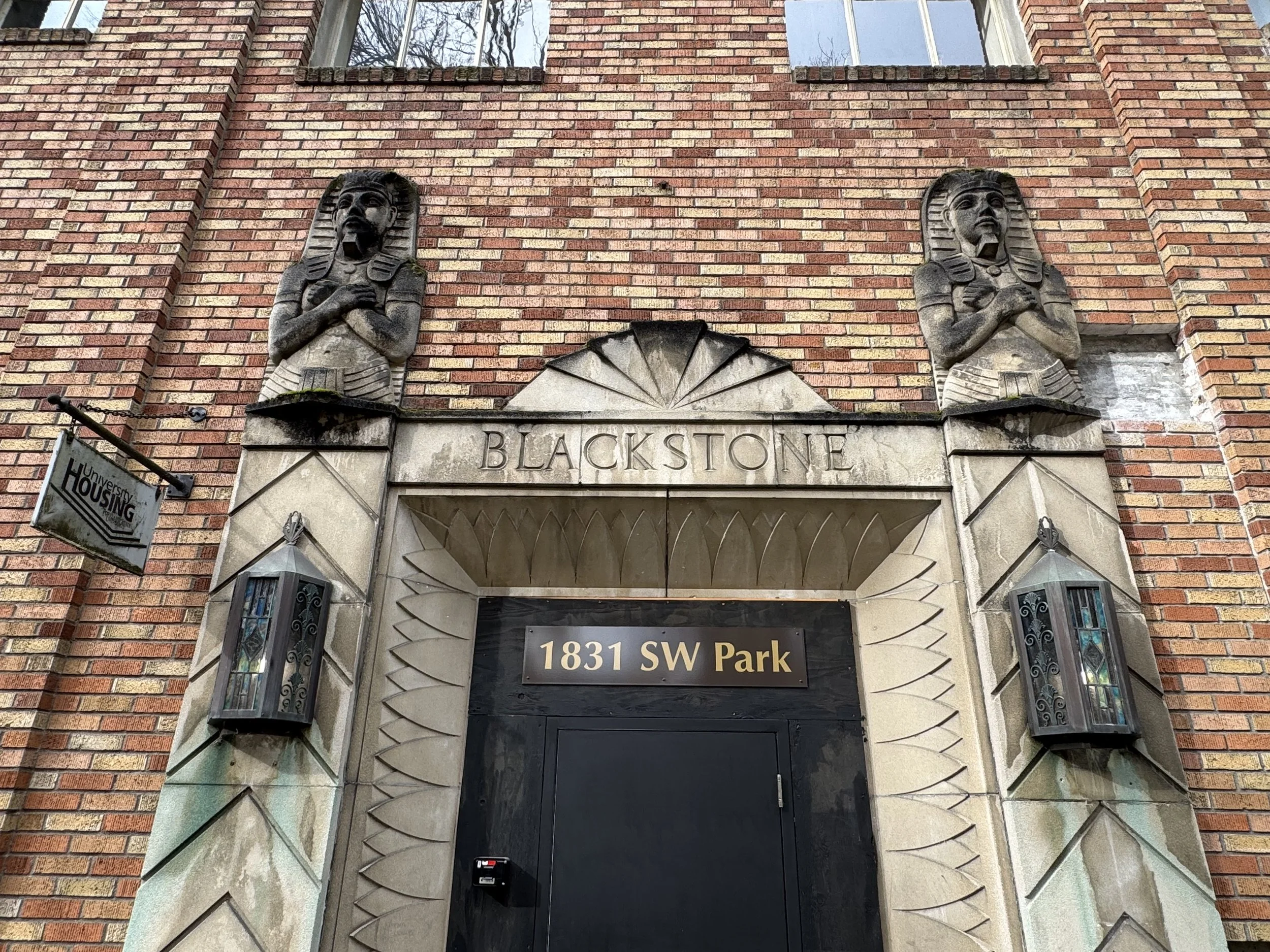
The Blackstone apartment building, designed by Elmer Feig, was constructed in 1930 by developer Harry Mittleman. It has four stories plus a ground level that is partly below grade. The style of the building is Egyptian Revival, part of the late 19th and 20th century pre-war Exotic Revival movement, and has flamboyant cast stone decoration, deeply inset multipane casement windows, and polychrome raked brick. Its layout features a light court allowing for a “C” shaped corridor and natural light to come inside the units. At least 24 of Feig’s designs are on Portland’s Historic Resource Inventory and four are individually listed on the National Register of Historic Places (NRHP).
The Blackstone is individually architecturally significant at a local level under National Register criterion C, and is also potentially locally significant under National Register criterion A for its role in the student-led housing movement just after the building was acquired in 1969 by Portland State University. A student-led, nonprofit corporation lasted several years and managed a total of nine buildings for PSU students. All but one are now demolished or (as the case with the Montgomery and the Blackstone) proposed to be demolished.

Montgomery: In 1911,Henrietta Failing sold the quarter block at SW 10th Avenue and Montgomery St. to the Portland Women’s Union (PWU). The PWU, a philanthropic organization formed in 1887 to house “young women wage earners who are strangers in the city.” Architect Albert E. Doyle designed a Georgian style red-brick building, L-shaped in plan, with a chamfered corner entry and a rear courtyard for the site; this part of the building was completed in 1917. By 1920, the Martha Washington hotel, as it was called, housed 95 young women, and more than 200 names were on the waiting list. The building also served as the meeting place for the PWU and hosted numerous other events. A 1925 north wing addition was designed by Lawrence and Holford and created a C-shaped plan for the building overall. It is four stories with full daylit basement.
The Martha Washington Hotel, now Montgomery Court, is eligible for the NRHP at the state level for its importance under Criterion A in women’s history. It is also individually locally eligible under Criterion C for its architecture.
Challenge: Portland State University plans to demolish these two historic residential buildings to make way for new student housing.
Preferred outcome: These two buildings, both of which were part of Portland long before they were purchased by PSU, could have been renovated for residential use and to preserve their historic value to the City and the State utilizing creative funding solutions. Additional student housing could be built on existing empty lots on campus. The two buildings abut two NRHP-listed historic properties, the Simon Benson house and the South Park Blocks and their loss will significantly diminish the unique sense of place in this beloved public space.
Current status and Timing: Despite vigorous advocacy from the Architecture Heritage Center, the Downtown Neighborhood Assn, and hundreds of petition signers, the PSU Trustees voted to replace the dorms. No legal levers exist to prevent it since the dorms were never officially designated as historic. Demolition could begin in late 2026.
Decision maker: PSU Board of Trustees.
Action taken/needed: Petition; letters; testimony at PSU Trustees meetings; outreach to local leaders. No further actions appear feasible. However, because these buildings were eligible for the National Register of Historic Places, PSU is required to execute mitigation for their loss. The AHC has called for mitigation to include, at a minimum, the nomination of two remaining historic buildings to the National Register, the salvage and/or incorporation of key architectural features in the new building or its grounds, and an installation that illuminates the significant womens’ history of the Martha Washington Hotel.
Lessons learned: PSU has planned to demolish all of the beautiful, but unreinforced masonry residential buildings that it has acquired since the late 1960s. Without public pressure to preserve specific buildings, decisions will continue to exclude the public. There are three reasons for this. First, the funding mechanism (the Oregon Higher Ed board funds capital projects) is cost driven, favoring new buildings over renovations. Second, PSU’s decision to not historically designate any of its buildings (and therefore invite a public process) and keep its master planning internal makes it difficult for the public to receive advance information. Finally, however, seismic work is very expensive. Potentially, a design that allows for partial preservation and seismic work paired with an addition or new construction might help convince PSU to play a better stewardship role, but so far PSU has been disinterested in such an approach on campus.
For more information: