THE KELLER AUDITORIUM
222 SW Clay St, Portland, OR 97201
Updated 9-10-26
Description & Significance:
Opened as the Public Auditorium on July 4, 1917, the Keller Auditorium building has been a Portland landmark for more than 100 years. Portland Symphony Orchestra (now the Oregon Symphony) first performed there in October 1917. Over its first few decades, the Auditorium functioned as a concert hall, movie house, meeting hall and, grimly, as a makeshift hospital and morgue during the 1918 flu pandemic. However, by the early 1960s, the performance space was crowded and suffered from poor sightlines and acoustics. The mechanical systems were inadequate, and life safety was a serious concern.
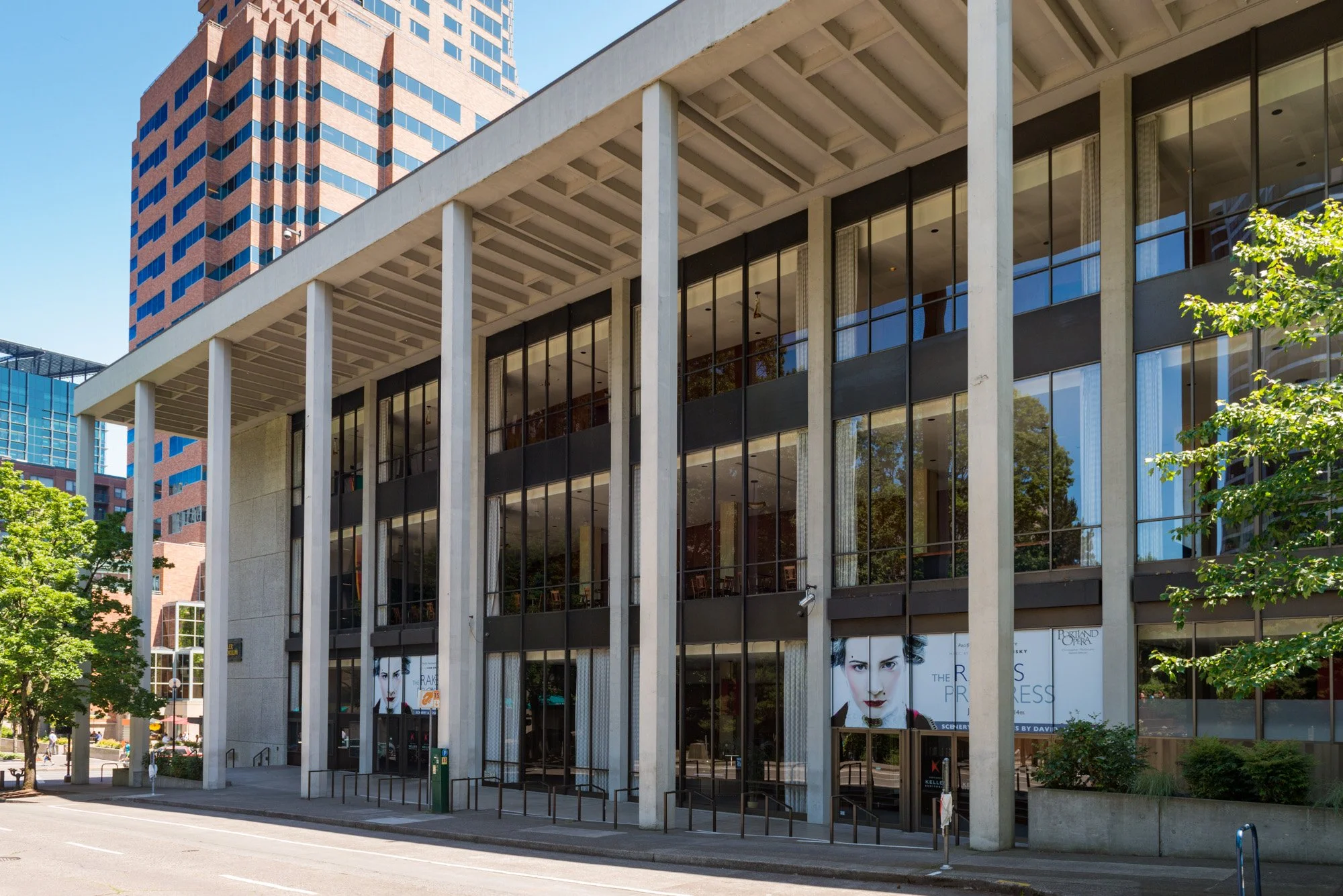
After a successful ballot initiative in the mid-1960s, the renamed Civic Auditorium was reinvented as part of the South Auditorium District Urban Renewal project. This transformed the building’s external character, replacing the original brick facade with mid-century concrete and quartz panels and a grand arcade facing Third Avenue.
Also part of the South Auditorium District redevelopment, Lawrence Halprin’s Portland Open Space Sequence created an open space network of parks and pathways that set the stage for large-scale office buildings and housing. Ira Keller, for whom both the auditorium and the Halprin-designed Keller Fountain are now named, was the first chair of the Portland Development Commission.
The Keller serves as the home of Broadway in Portland, the Oregon Ballet Theater, the Portland Opera, Oregon Children’s Theater, and other major events. The Halprin Portland Open Space Sequence, including the Keller Fountain, is listed on the National Register of Historic Places as a significant work of urban design.
Challenge:
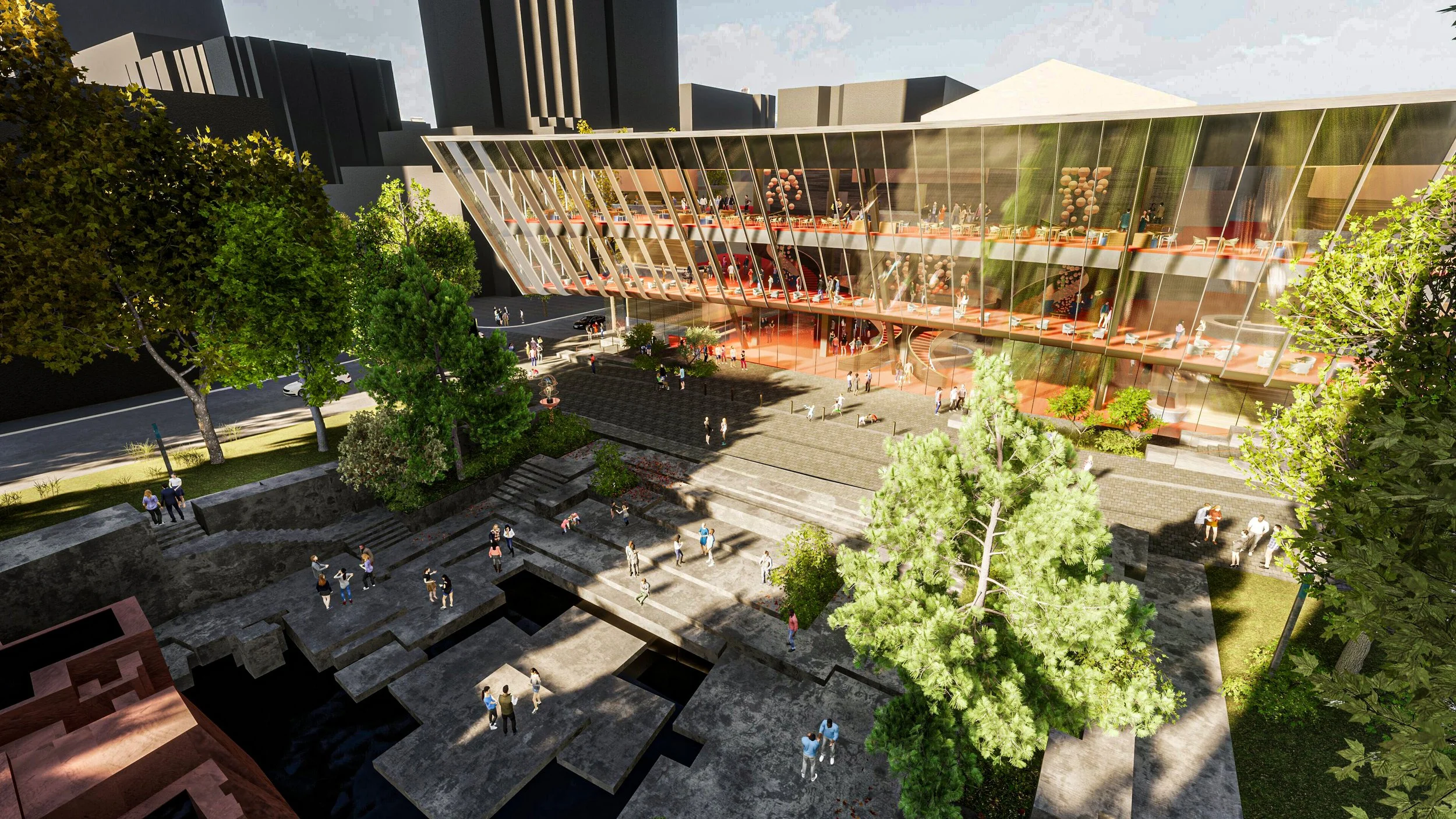
The Keller has documented shortcomings in lobby and other circulation space, acoustics, and seismic structural conditions. The Our Next Keller organization (https://ournextkeller.org) has compiled detailed design and financial plans, to renovate the Keller, inside and out, as a 3,000-seat theatre, with updated backstage, circulation, and acoustic conditions that would fully meet the needs of large scale Broadway shows – a critical source of revenue. Those plans are presented in A Keller Renaissance: Final Report Keller Auditorium Feasibility Study. The estimated cost of modernizing the Keller is about $236 million.
In 2024, Portland State University (PSU) proposed a new Performing Arts Center at the University Place Hotel site, six blocks south of the Keller. The current PSU plans would include a 3,200-seat performing arts space that would replace the Keller, a smaller 900- to 12,000 seat theater, studios and support space, and a hotel. The PSU plan, is estimated to require over a $400 million budget.
Preferred outcome:
A Keller Renaissance: Final Report Keller Auditorium Feasibility Study provides a path forward to enhance the Keller as a large performing arts space with strong public connections to the Keller Fountain and the Open Space Sequence and downtown Portland. The budget estimates are substantially lower than a new project at PSU.
AHC and Restore Oregon have considered the Keller renovation plans and strongly support this upgraded Keller performing arts center. The plan has financial feasibility and would bring the environmental benefits of renovating a building with embedded carbon. Though concerns have been raised about revenue losses during the months of closure needed for the renovation, we believe other large venues can bridge that period, and offering compensation to staff during any furlough period still cost millions less than abandoning the Keller for the PSU proposal.
Current Status and Timing:
The plans to rebuild the Keller have drawn much public interest and comment. The City Council held hearings on the Keller proposals. Strong support for rebuilding the Keller has been cited with a 2024 survey reporting 66% in favor.
A recent study revealed clearly that there is insufficient market support to renovate the Keller and build at PSU. So it’s one or the other. There are no economically viable options to repurpose the Keller, so to pursue the more costly – and environmentally far more damaging – option of PSU would create a physical and economic hole in downtown that the city cannot afford.
Save The Keller is currently advocating for a 10-15 million dollar fix instead of a multi-million-dollar renovation.
Update Sept 10, 2026
On September 9th, Portland City Council voted to take the next step in replacing the Keller and renovating it into a smaller venue. No money was allocated, however.
Decision maker:
The Portland City Council is currently reviewing city budget priorities that could include funding the Keller renovation. The date on which they will make a decision remains unclear.
Action needed:
AHC urges outreach to Mayor Keith Wilson and to City Council members to make the right decision for a Keller renaissance:
Appoint appropriate committees to support the Keller renovation and the integrity of the Open Space Sequence.
Approve funding in 2026 for further design and planning.
Put a Keller renovation bond before the voters in 2026-2028.
Find more information:
Vote Keller: Preserve Resources, Strengthen Portland’s Economy, and Revitalize Downtown - Architectural Heritage Center and Restore Oregon
Our Next Keller (https://ournextkeller.org)
A Keller Renaissance: Final Report Keller Auditorium Feasibility Study (https://static1.squarespace.com/static/5f724b5dfea23f4f75261ed4/t/663e61e260852e0cb730d61d/1715364330719/Keller+Feasibility+Study+Project+Revised+Report_FINAL+2.pdf)
Keller Auditorium Should be Renovated – Not Abandoned - Diana Stuart, Downtown Neighborhood Association Board Member
Recommendation from the Steering Committee
Two views: Keller Auditorium and/or PSU Performing Arts + Culture Center? By Oregon Artswatch
Does Keller Auditorium have future if PSU facility is pursued? By Allen Classen