
UNION STATION
Challenge:
Though not under immediate threat of demolition, the station faces a compounding set of risks. Deferred maintenance and critical infrastructure needs — including seismic retrofitting of its unreinforced masonry structure — are estimated to cost $250–$300 million. Prosper Portland, the city's economic development agency and owner since 1987, has been seeking a buyer for close to a decade. Amtrak, the primary tenant and lead candidate, formally backed away from purchase discussions in 2024. As of the date of this report, no sale has been made. The Trump administration's threats to cut Amtrak funding and the resignation of Amtrak's CEO in March 2025 have further narrowed the field of viable buyers.
Preferred outcome - Path for Reuse or Repurposing
The station remains fully operational, serving 657,341 Amtrak passengers in fiscal year 2024, with direct connections to TriMet MAX, Portland Streetcar, and multiple bus lines. Continued rail-focused use is the clearest path forward. Proposed building upgrades include ADA (Americans with Disabilities Act) accessibility improvements, redesigned passenger spaces, and new mechanical and electrical systems. Its NRHP listing makes the building eligible for the 20% Federal Historic Tax Credit, a powerful tool to attract mission-aligned private investment. A mixed-use adaptive overlay — incorporating dining, retail, and cultural programming in the model of Denver Union Station or Los Angeles Union Station — could generate ancillary revenue to support ongoing maintenance.
Timing:
On going
Action needed:
Community support has been demonstrated repeatedly. In 1985, the Pacific Northwest Chapter of the National Railway Historical Society and the Oregon Association of Railway Passengers successfully raised funds to restore and relight the iconic neon signs on the clock tower. ODOT, TriMet, rail advocacy groups, and the Oregon State Historic Preservation Office all have active interests in the station's future. Peter Meijer Architect, PC (PMA), the preservation architect of record for the station's conditions assessment and improvement planning, could provide critical technical institutional knowledge to support advocacy and future ownership transitions.
Find more information:
800 NW 6th Avenue · Portland, OR
Updated April 2026
Significance:
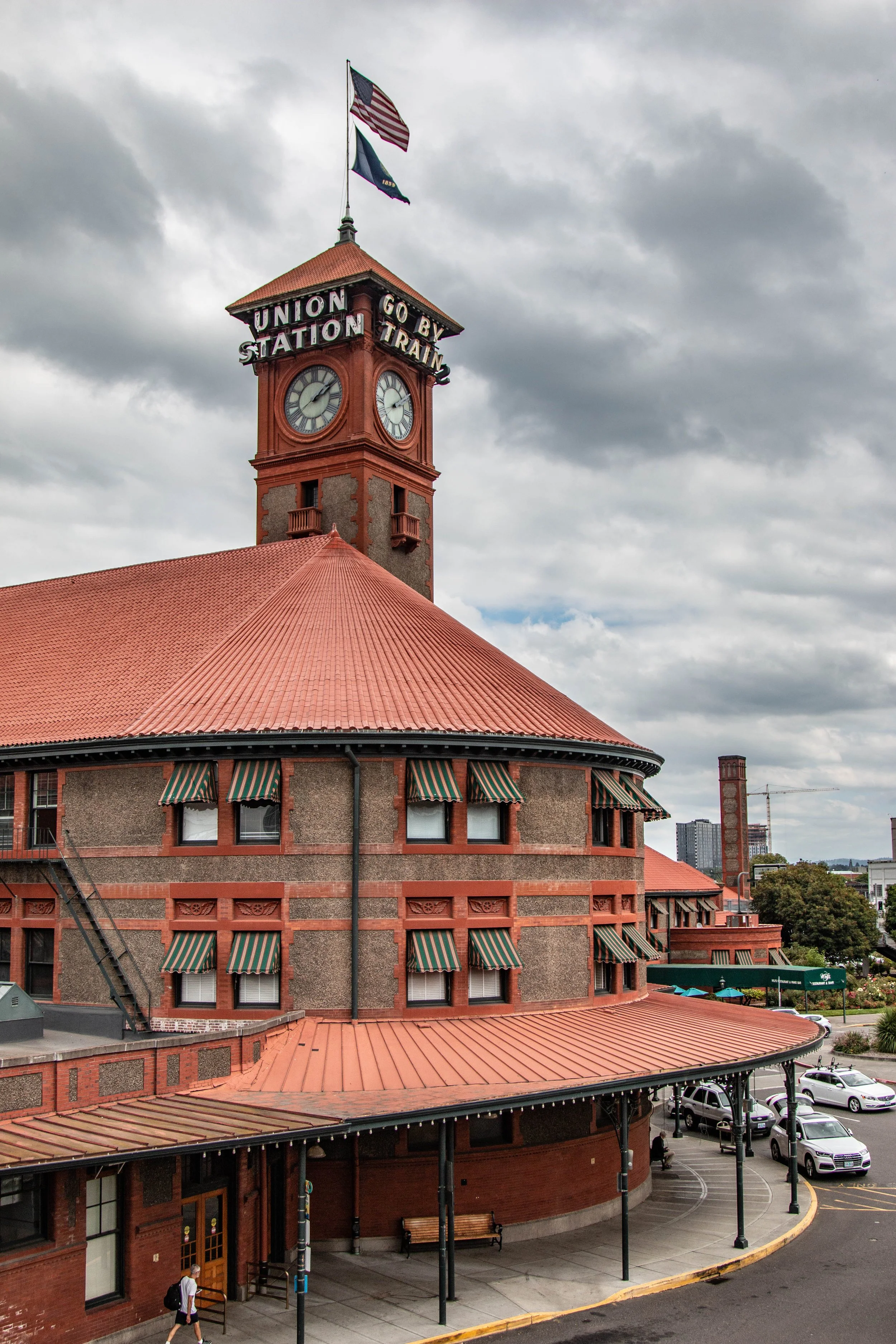
Portland Union Station is the oldest continuously operating major passenger terminal on the West Coast, opening February 14, 1896. Designed in the Richardsonian Romanesque style by the Boston/Kansas City firm Van Brunt & Howe, the building features a distinctive 150-foot clock tower topped with a four-sided Seth Thomas clock — a fixture of Portland's skyline for 130 years. It was added to the National Register of Historic Places in 1975 and was named by National Geographic in 2025 as one of eight "historic design marvels" among America's most beautiful train stations.
Union Station also holds deep significance in Portland's Black history. The station served as a key arrival point for Black railroad workers, including the Pullman porters, whose presence helped establish and grow Portland’s Black community during the early and mid-20th century. The station was also a central location where families and communities gathered, especially during periods of migration and economic opportunity, making it a site of both historical and cultural importance for African American residents in the region. These connections reflect Union Station’s enduring role as a bridge between cultures and generations in Portland’s story. An update to the National Register of Historic Places (NRHP) is underway to put on record this important cultural significance.